
One-Way vs Two-Way Doors
Not every decision deserves a meeting. But try telling that to some organizations, where even choosing a linting rule somehow requires stakeholder alignment and a follow-up meeting.
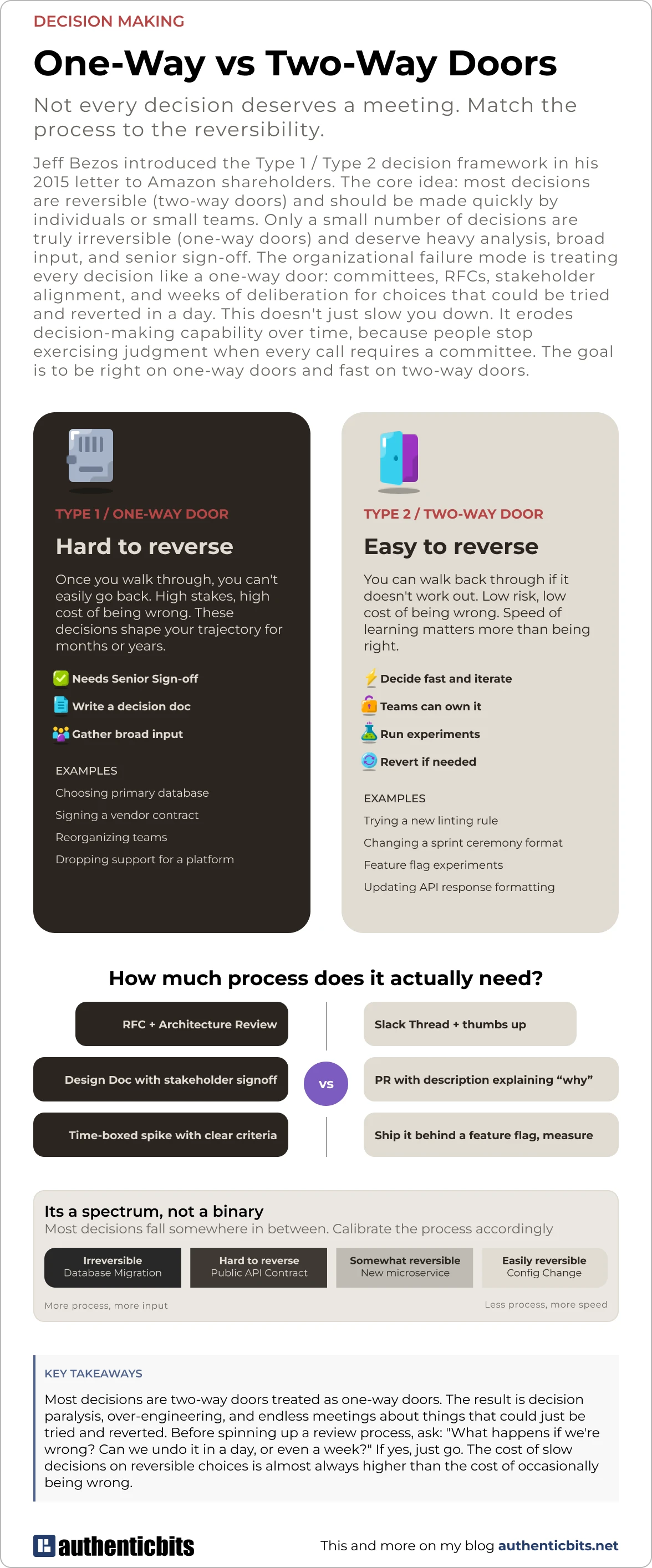
Jeff Bezos introduced the Type 1 / Type 2 decision framework in his 2015 shareholder letter. The core idea: most decisions are reversible (two-way doors) and should be made quickly. Only a small number are truly irreversible (one-way doors) and deserve heavy analysis.
Why This Matters
What many organizations get wrong: the real cost isn’t making a bad decision on something reversible. The real cost is the paralysis that comes from treating everything like it’s permanent. When you require extensive process for decisions that could be undone in a day, three things happen. First, you miss opportunities while competitors test and learn faster. Second, you train people to stop exercising judgment and wait for permission on everything. Third, you create a culture where being slow looks thorough and being fast looks reckless.
The One Question That Matters
Before spinning up a review process, ask: “What happens if we’re wrong? Can we undo it in a day or even a week?” If yes, just ship it. The cost of slow decisions on reversible choices is almost always higher than the cost of occasionally being wrong. If no, or if reverting would be painful, then yes, take your time. Get input. Write the doc. Make sure you’re right. The failure mode is using the same process for everything. When you require an RFC for a config change, you’re not being thorough, you’re being bureaucratic.
The Real Goal
Be right on one-way doors and fast on two-way doors. Start small. Pick one type of reversible decision your team makes regularly. Give someone permission to just make the call and ship it. If it doesn’t work, revert it. The learning from doing that once is worth more than ten meetings about whether you should do it.
Most decisions are two-way doors. Start treating them that way.