
Innovation Dies in Silence
There’s a persistent myth in tech:
“If we hire smart people and give them autonomy, innovation will just happen.”
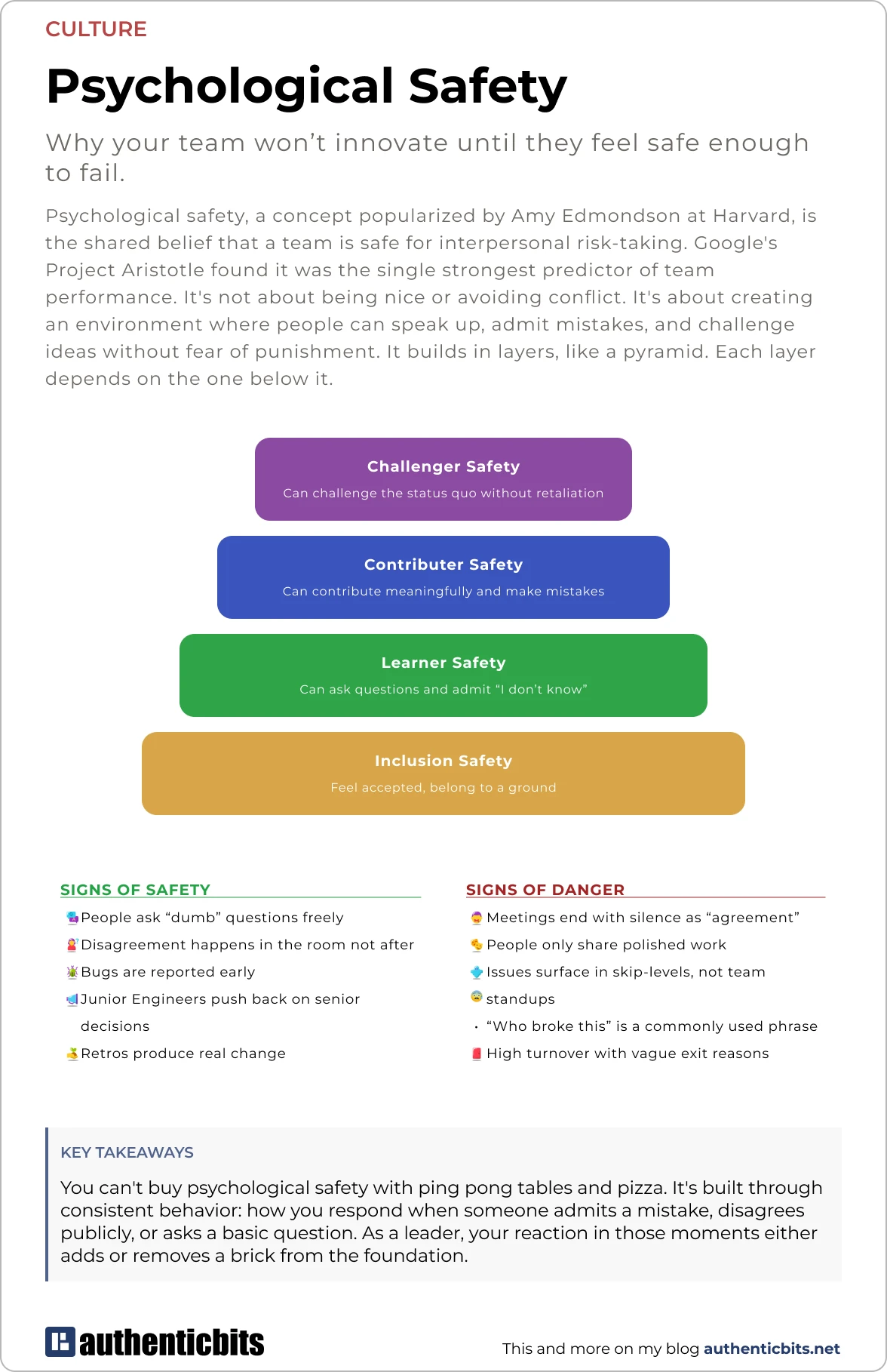
The term psychological safety was popularized by Amy Edmondson, a Harvard professor who defined it as a shared belief that a team is safe for interpersonal risk-taking.
Google’s famous Project Aristotle studied what makes teams effective. They analyzed seniority, personality types, management styles, and more. And the strongest predictor of high-performing teams?
Psychological safety.
But the term it is often misunderstood.
- It’s not about being nice.
- It’s not about lowering standards.
- And it’s definitely not about avoiding disagreement.
In fact, the opposite is usually true. The healthiest teams I’ve seen debated intensely. They challenged assumptions. They surfaced risks early. What separate these from dysfunctional teams isn’t the absence of tension, it’s the absence of fear.
Why the Pyramid Matters
Psychological safety builds in layers.
1. Inclusion Safety — “Do I belong?”
If people don’t feel accepted, they won’t speak up. Belonging is the base layer. Without it, everything above collapses.
2. Learner Safety — “Can I say I don’t know?”
If asking basic questions feels risky, learning slows down. Teams that hide confusion ship misunderstandings.
3. Contributor Safety — “Can I do real work and make mistakes?”
Ownership requires trust. If failure equals embarrassment, people optimize for safety — not impact.
4. Challenger Safety — “Can I disagree?”
This is where innovation lives. If junior engineers can’t push back on senior ones, you don’t have healthy debate — you have hierarchy.
Harvard Business Review summarized it as: psychologically safe teams are more likely to learn, innovate, and adapt.
Leadership Is the Multiplier
But you don’t build psychological safety with ping pong tables or pizza Fridays.
You build it in micro-moments:
- How you respond when someone admits a mistake.
- How you react when someone challenges you publicly.
- Whether you reward candor — or subtly punish it.
Every reaction either adds or removes a brick from the foundation. So if you want innovation, start here.
Safety first